

Heavy-Duty Joggling Machine for Pressure Vessel Cylinders
SweBend builds machines that solve forming challenges standard equipment cannot handle. For Spray Engineering, a sustainability-driven manufacturer in industrial equipment and process technology, the challenge was joggling heavy-wall pressure vessel cylinders – a tailored forming process of rolling profiled grooves into the shell to strengthen it, make it rounder, and let the wall absorb the pressure and volume changes that come with heat inside a boiler. The same operation, applied at the cylinder ends, forms the stepped offset that lets two sections overlap and weld together into a longer vessel. One process, two purposes.
Spray Engineering positions itself around “zero carbon emissions, zero energy waste” – building process equipment that helps heavy industry decarbonize. SweBend shares that ethos: machines built to last decades and adapt to new tooling rather than be replaced is sustainability built into the steel.
Key takeaways:
- Joggling is a metal-forming process where profiled rolls press a stepped offset (joggle) into a cylinder. Applied along the cylinder body, the same operation creates stiffening grooves – like the hoops on an oil drum – that strengthen the shell, make it rounder, and absorb pressure and thermal changes. Applied at the cylinder ends, it forms the stepped flange used to join two sections before welding.
- The JM-140 is a heavy-duty joggling machine from SweBend that forms these offsets using profiled rolls and 35 tons of controlled forming force.
- Customer: Spray Engineering, a sustainability-focused manufacturer of process equipment for energy- and resource-efficient industrial production. Their boilers and process vessels run under sustained thermal and pressure load – joggled stiffening grooves are what make the shells durable enough for industrial service.
- Handles mild steel up to 15 mm thick at 355 MPa yield, on cylinders from 1,000 to 5,000 mm in diameter.
- Application-specific profiled rolls can be swapped as joggle profiles evolve – the machine adapts instead of being replaced.
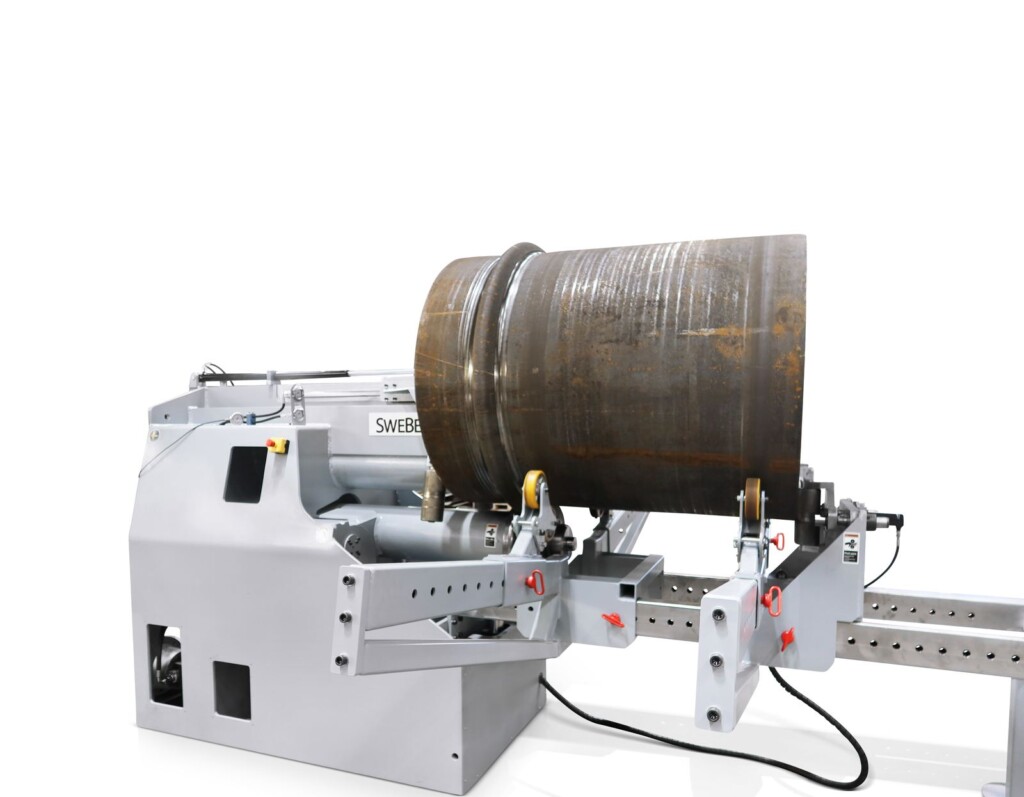
A heavy-wall cylinder on the JM-140 with circumferential stiffening grooves already rolled into the shell. These joggled grooves strengthen the cylinder and let the wall absorb pressure and thermal stress in pressure vessel service.
Joggling: one process, two purposes
Joggling rolls a profiled groove into a cylinder using two profiled rolls that press the material into a stepped offset. Where on the cylinder you joggle determines what the joggle does.
Strengthening the cylinder body. Rolling circumferential stiffening grooves – rillor in Swedish, like the hoops pressed into an oil drum – reinforces the shell against external collapse and internal stress, drives the cylinder into a more accurate circular cross-section, and lets the wall absorb pressure and volume changes as the gas or liquid inside the vessel expands and contracts under heat. For Spray Engineering, this is the primary reason the JM-140 was needed: their boilers and process vessels run under sustained thermal and pressure load.
Joining cylinder sections. Rolling a stepped flange at the cylinder ends lets two sections overlap and sit flush at a welded joint, building up longer pressure vessels from individual rolled cylinders.
The JM-140 is a tailored forming machine built for this dual role: same machine, same forming principle, same profiled rolls – swapped to match the joggle profile being formed.
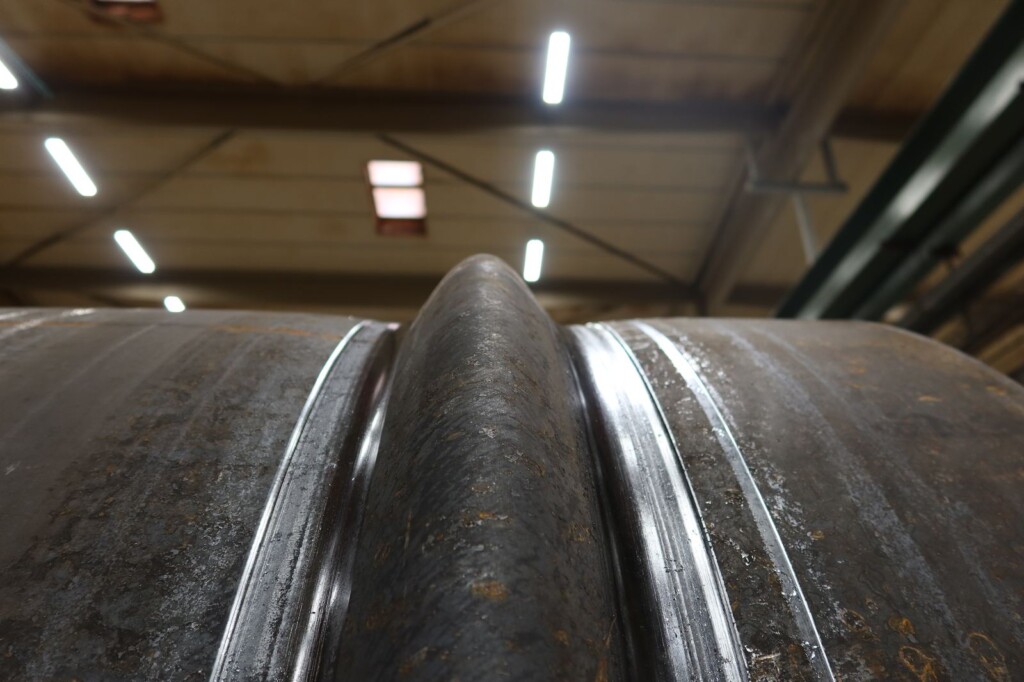
Circumferential stiffening grooves rolled into the cylinder wall - the rillor that reinforce a pressure vessel shell, improve its roundness, and let it absorb pressure and volume changes under heat.
Precision positioning for consistent flange geometry
Accurate cylinder positioning is critical in joggling – misalignment leads to uneven forming and scrapped parts. The JM-140 features adjustable vertical support rolls that hold the cylinder in position, combined with horizontal outboard support rolls that carry the cylinder’s weight during forming. This dual-support system keeps the workpiece stable throughout the process, reducing operator intervention and improving repeatability.
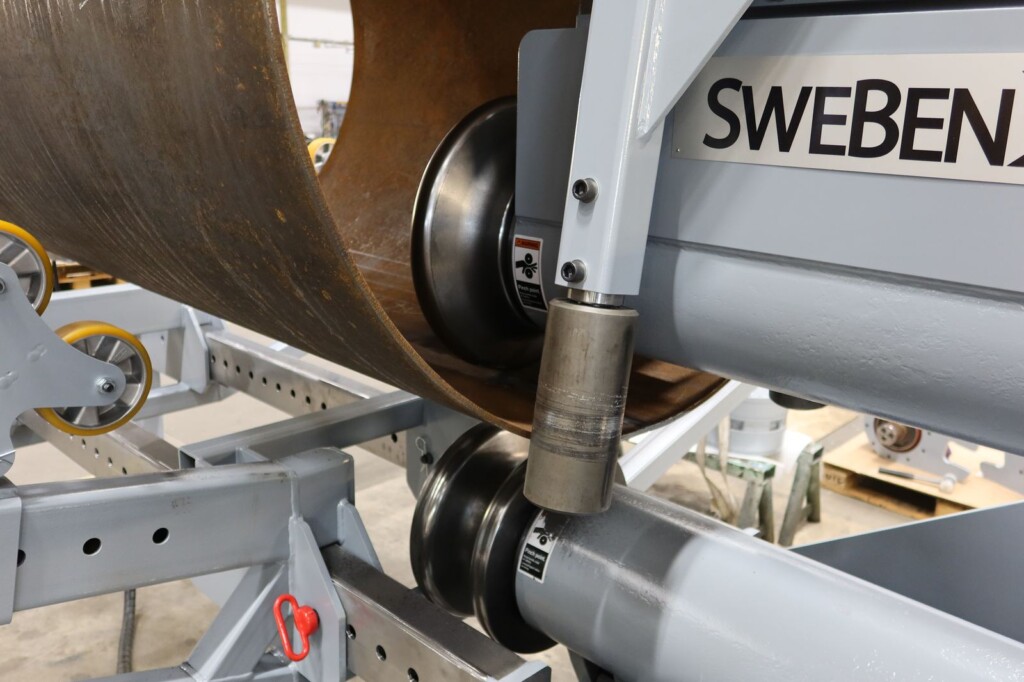
The profiled rolls of the JM-140 press the cylinder wall between matched groove geometries. The outboard support roll below carries the cylinder's weight, keeping the joggle even around the full circumference.
Capacity built for demanding production
The machine handles mild steel plates up to 15 mm thick at 355 MPa yield (EN 10025 S355JR), forming cylinders ranging from 1,000 mm to 5,000 mm in diameter, with lengths up to 2,500 mm. The forming roll delivers up to 35 tons of force at speeds up to 15 m/min, driven by a 22 kW hydraulic system operating at 210 bar. These capacities give Spray Engineering the range to joggle a wide variety of pressure vessel cylinders without switching setups.
Built for strength, control and precision
Every component is sized for sustained heavy-duty operation. SKF bearings in all journals ensure long service life under continuous load. The hydraulic drive with variable speed gives operators precise control over the forming process, while the adjustable working pressure on the pinching roll allows fine-tuning for different plate thicknesses and flange geometries.
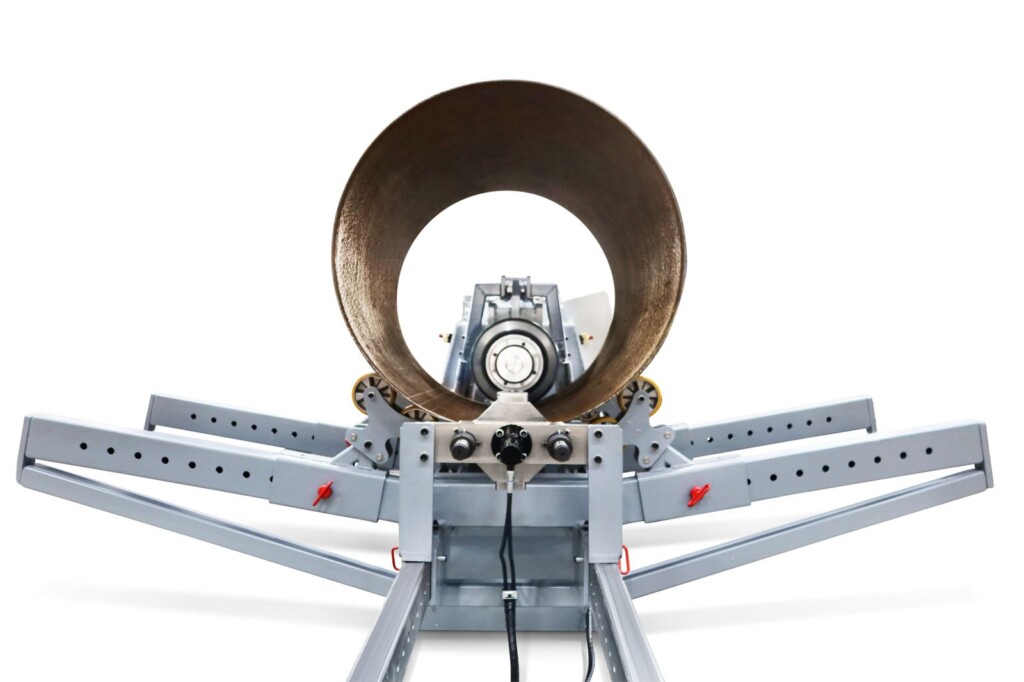
Seen end-on, the JM-140's outboard support rolls splay out in a V to cradle the cylinder. The horizontal forming layout lets cylinders load from the side instead of being lifted in from above.
Simple, safe, effective control
The JM-140 uses a dedicated control panel with push buttons and an emergency stop – designed for straightforward, safe operation without unnecessary complexity. A portable pendant control lets the operator inspect and adjust the joggling process from any angle around the cylinder – no fixed station, no blind spots. Operators focus on the process, not the interface.
Designed for today. Prepared for future parts.
The forming rolls are application-specific, but the machine is designed to accommodate new roll sets as production requirements evolve. When Spray Engineering introduces new joggle profiles, vessel geometries, or plate thicknesses, the tooling adapts – the machine does not need to be replaced. This philosophy runs through SweBend’s approach to custom machine projects across industries.
Technical Insight
“The forming rolls need to match the groove geometry exactly. Get that wrong, and force distribution becomes uneven across the flange – you end up fighting the material instead of shaping it.”
– Peter Nilsson, CEO & Founder, SweBend
Intelligent precision. Swedish craftsmanship.
SweBend. Built around YOUR Bend.
Post author

Peter NilssonCEO & Founder
With decades of experience in bending technology and industrial metal forming solutions.
